
Canyoning in Bali
Everything you need to know before you go: the two canyon areas, the six routes, who can join, safety, and how to plan your day. Written by the team that runs trips in these canyons.
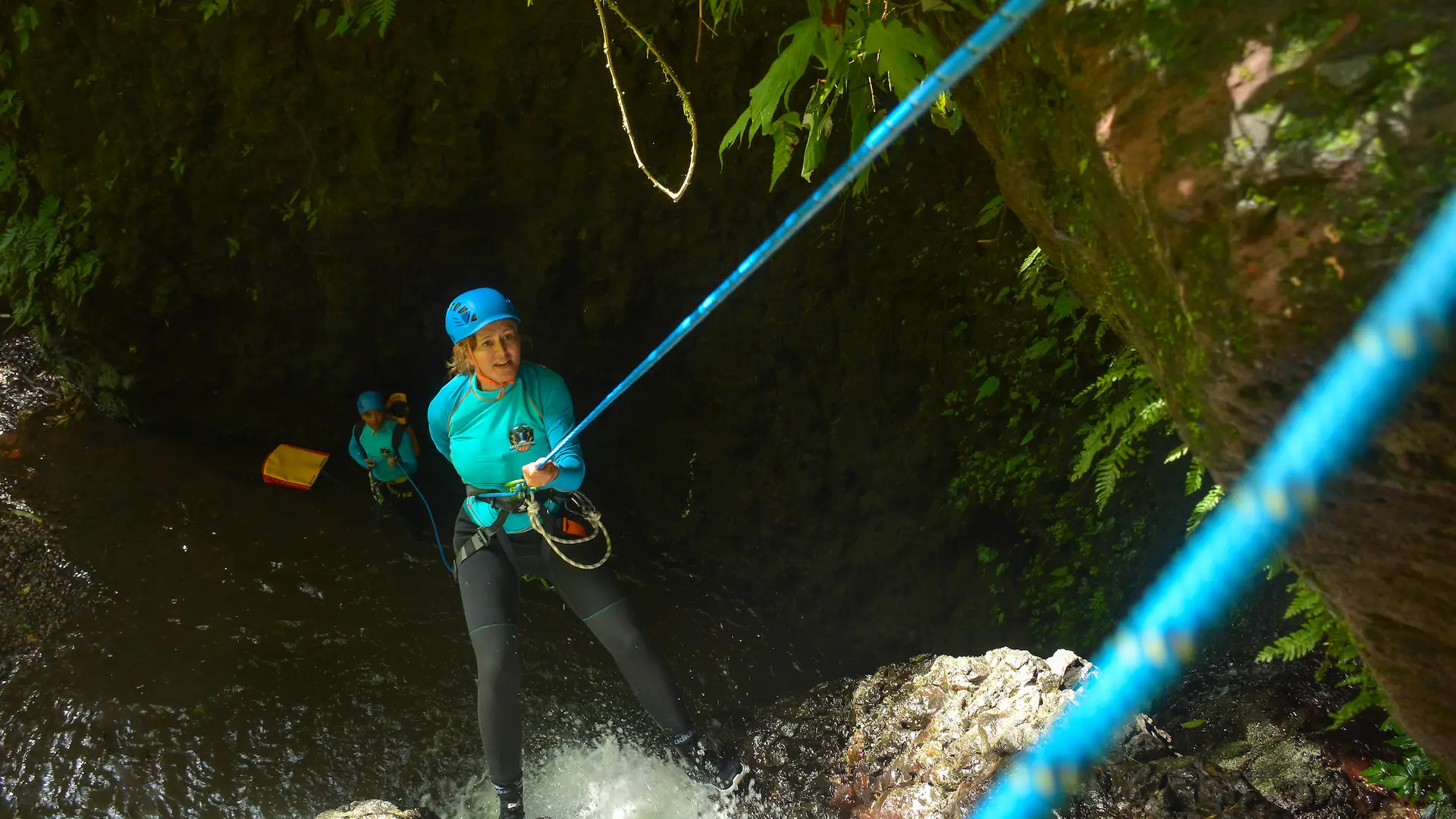
Explore TripsCanyoning means going down a canyon by following its river. You go down rock walls on a rope, jump into pools, slide down smooth rocks, and swim or walk through the water until you reach the end of the route.
Bali is famous for its beaches and waterfalls. Canyoning is different from a normal waterfall visit. You don’t just stand at the bottom and take a photo. You go down the waterfalls yourself.
Almost all canyoning in Bali is in the north, in Buleleng Regency. There are two main areas: Gitgit and Sambangan. They are very different. Gitgit is higher up, and the water is colder. Sambangan is lower, the water is warmer, and the routes are harder.
Beginners can do this. The routes are not easy, but our guides know these canyons well, and they set up and check every rope for you.
Where Are the Canyons?
Most visitors stay in the south of Bali, in Canggu, Seminyak or Kuta, or in Ubud. North Bali is on the other side of the island, across the mountains in the middle.
The canyons are in the hills of Sukasada district in Buleleng Regency, south of Singaraja, the main town on the north coast.
| From | Distance | Driving time |
|---|---|---|
| Ubud | 60 km (37 mi) | about 2 hours |
| Canggu / Seminyak | 67 km (42 mi) | about 2.5 hours |
| Lovina | 24 km (15 mi) | about 50 minutes |
| Singaraja | 12 km (7 mi) | about 20 minutes |
From the south of Bali, canyoning takes a full day. Plan your day around it.
What You Do on a Canyoning Trip
In canyoning, you follow the river down the canyon. On one trip, you will do several things:

Abseiling
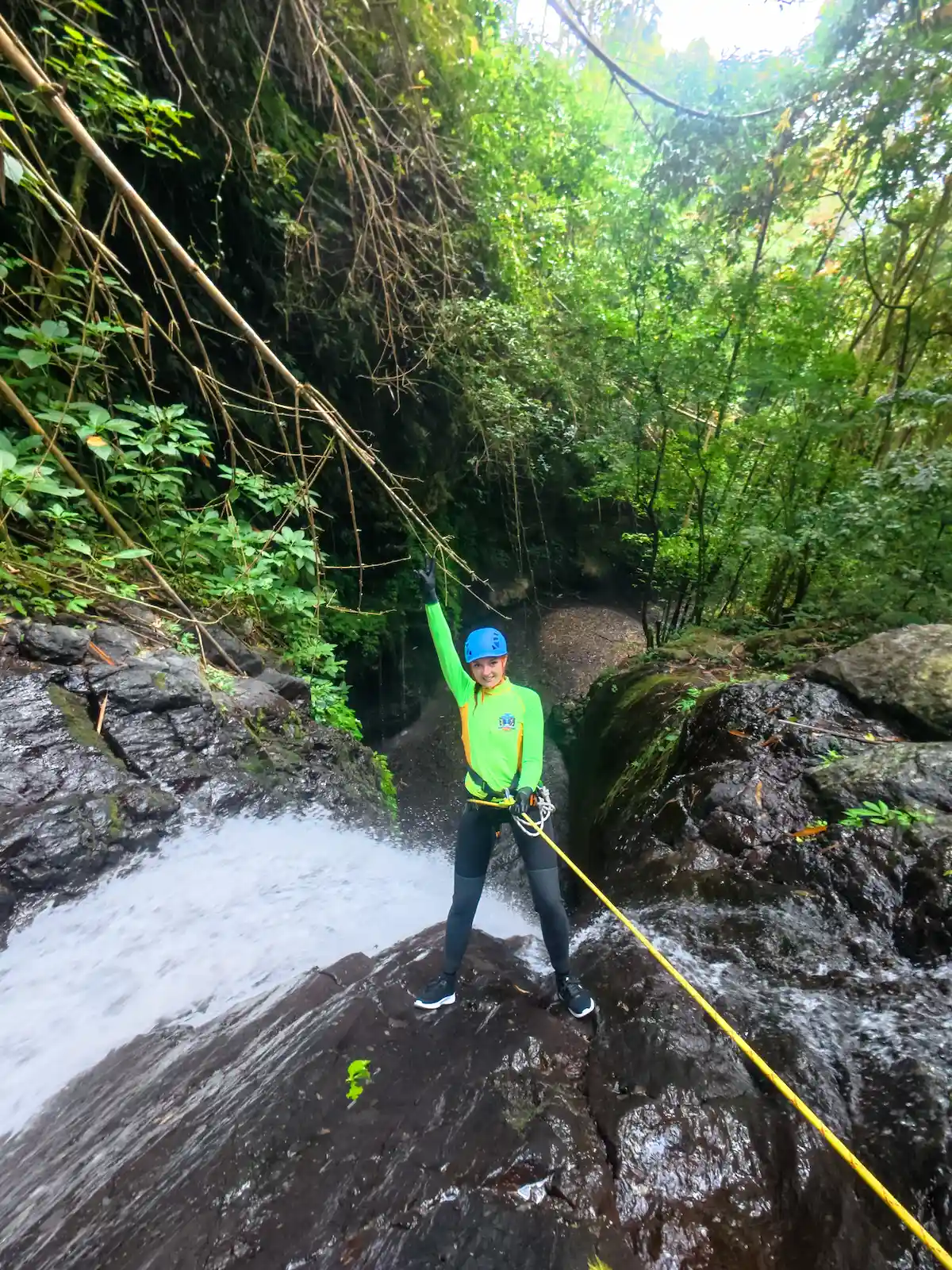
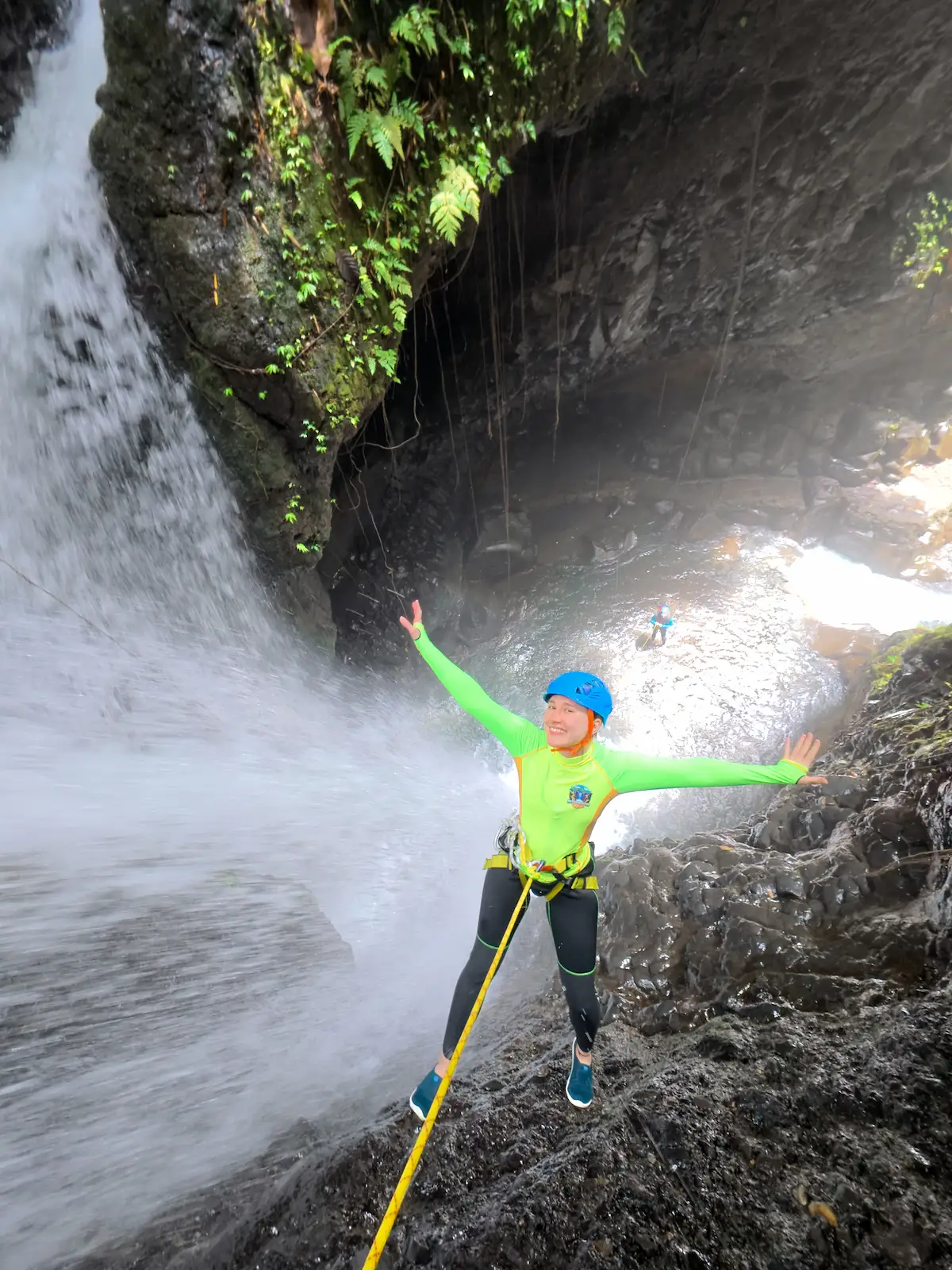
going down rock walls or waterfalls on a rope (called rappelling in the US)

Sliding
going down smooth, natural rock slides

Zip line
riding a cable across the canyon, also called a flying fox

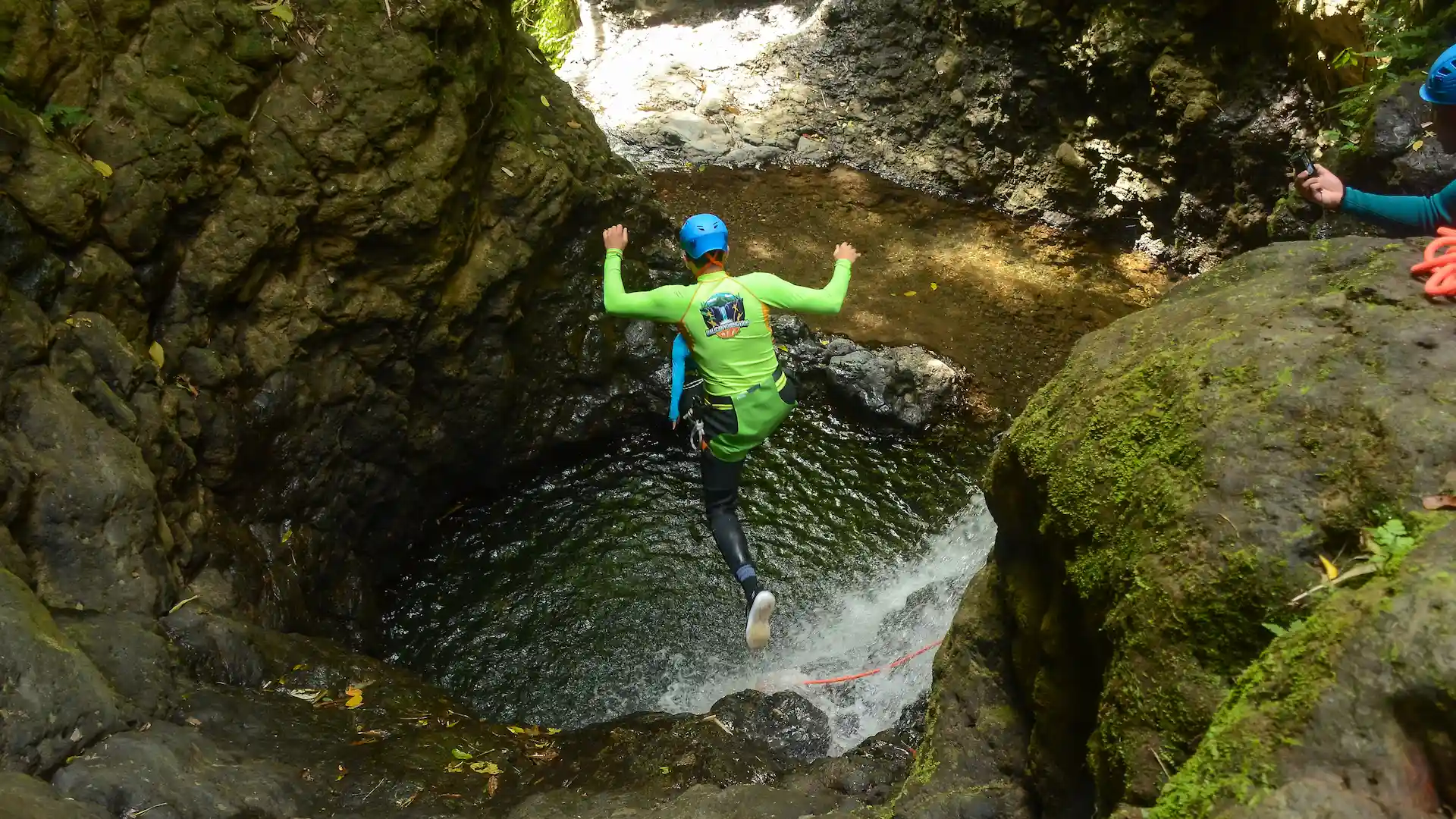
Jumping
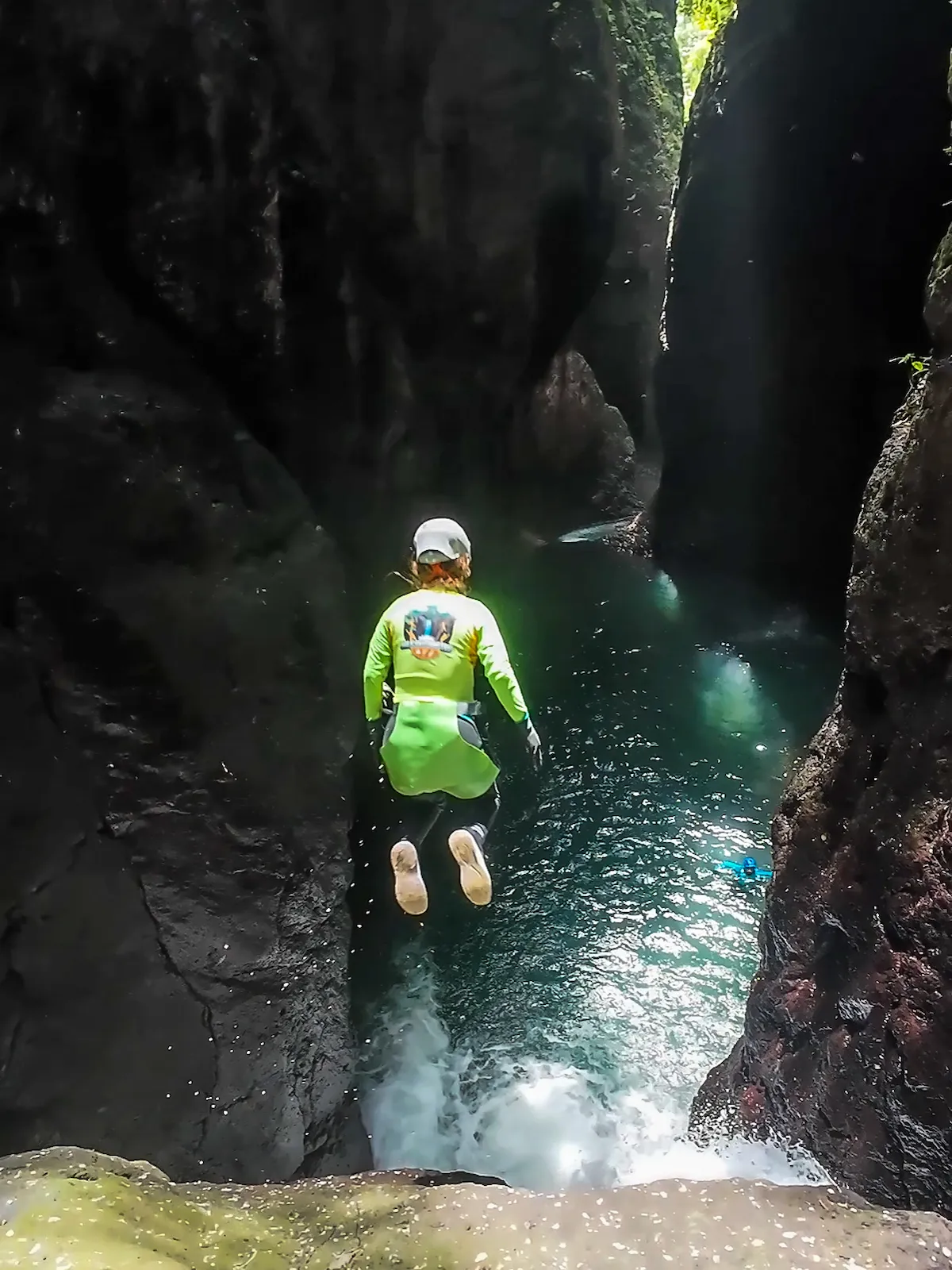
jumping into natural pools

Down-climbing
climbing down rocks where you don’t need a rope

Trekking
walking between the different parts of the route
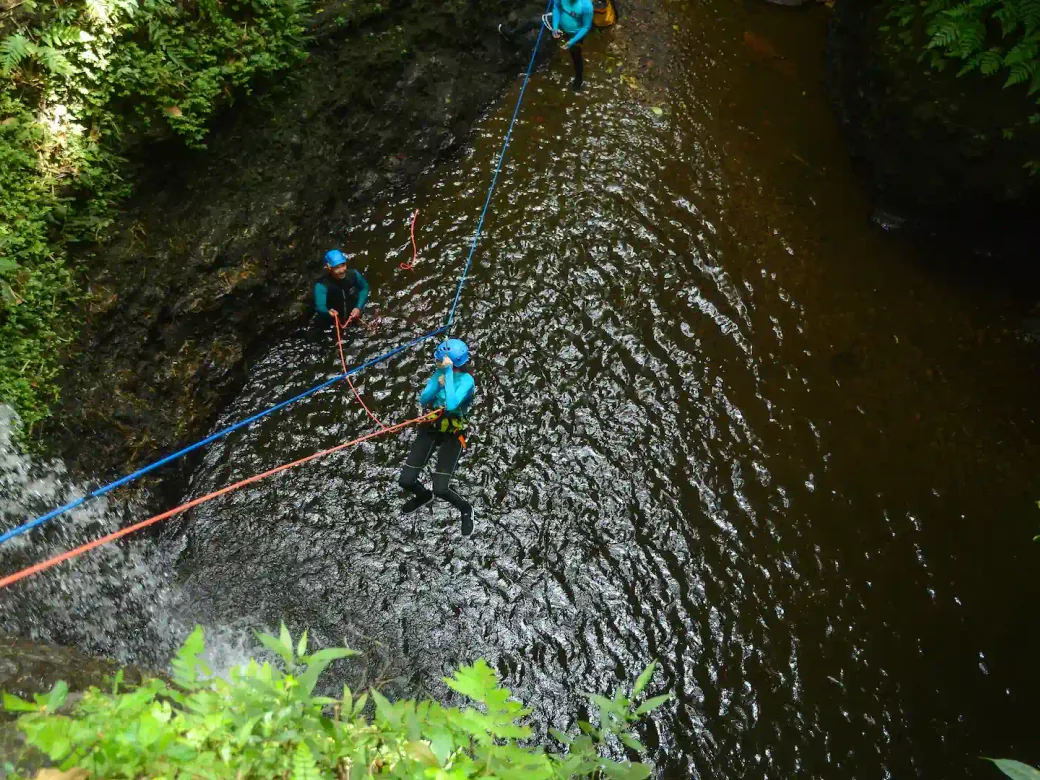
What you do, and how much, depends on the route. See the routes section below for details.
You use standard canyoning gear: a helmet, wetsuit, harness, ropes, carabiners (metal clips) and a descender (a device that controls your speed on the rope). Your guide sets up and checks everything before you go down. At the start, you get a briefing that explains each piece of gear and how it holds your weight.
There are two kinds of canyons. Dry canyons have no river, so most of the work is with ropes and rock. Wet canyons have water flowing through them the whole way, so you also deal with the current and with water levels that change. All canyons in Bali are wet canyons.
You may see different names for this sport: “canyoning” in Europe and Australia, “canyoneering” in the United States, and “kloofing” in South Africa. Some people use the first two names for different kinds of canyons (dry or wet), but not everyone does. In Bali it doesn’t matter, because all the canyons have water.
The sport started in Europe in the late 1800s, when cave explorers began using ropes to reach places they could not get to on foot.
Why All of Bali’s Canyons Are in the North
A canyon needs three things: hard rock for the walls, a steep slope, and a river that flows all year. North Bali has all three.
The rock here comes from old volcanoes. Over thousands of years, the rivers cut into this rock and made pools and long grooves in the canyon walls. You will see these grooves on both sides of you all the way down.
The water comes from an unusual place. In many places along the routes, it comes out from under the rock. It starts as a very small stream and gets bigger as more of these small springs join it.
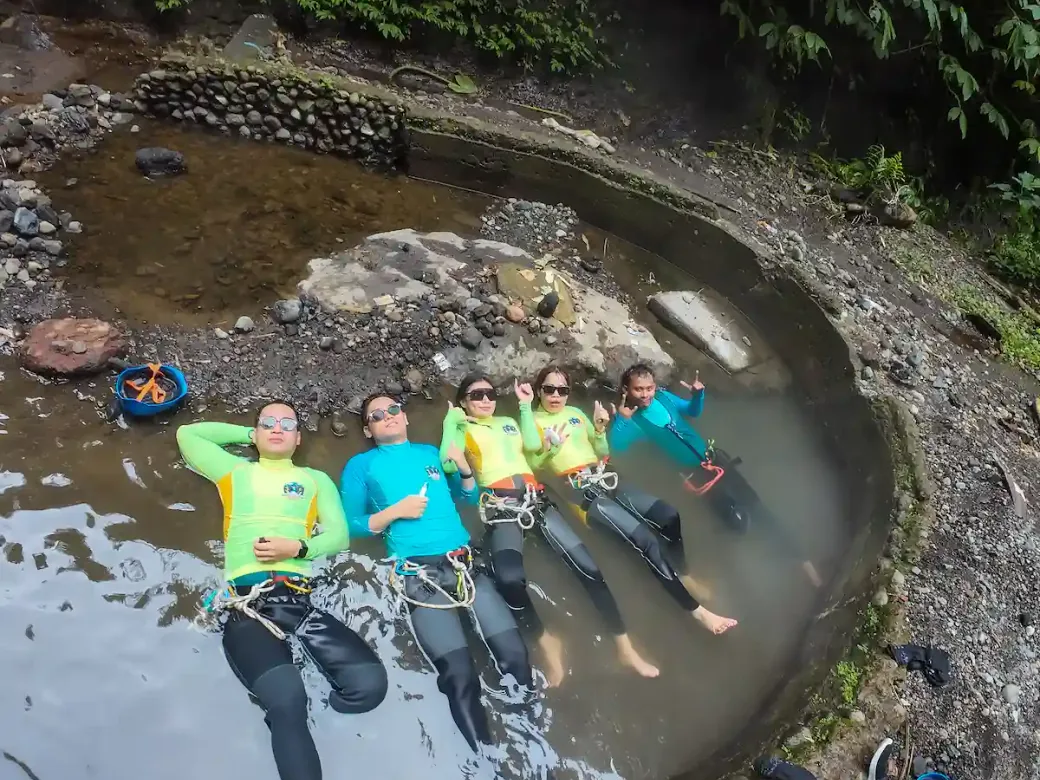
Gitgit has something the other routes don’t have: a hot spring partway down the route. It is small, but it shows that the ground here is still warm from the old volcanoes.
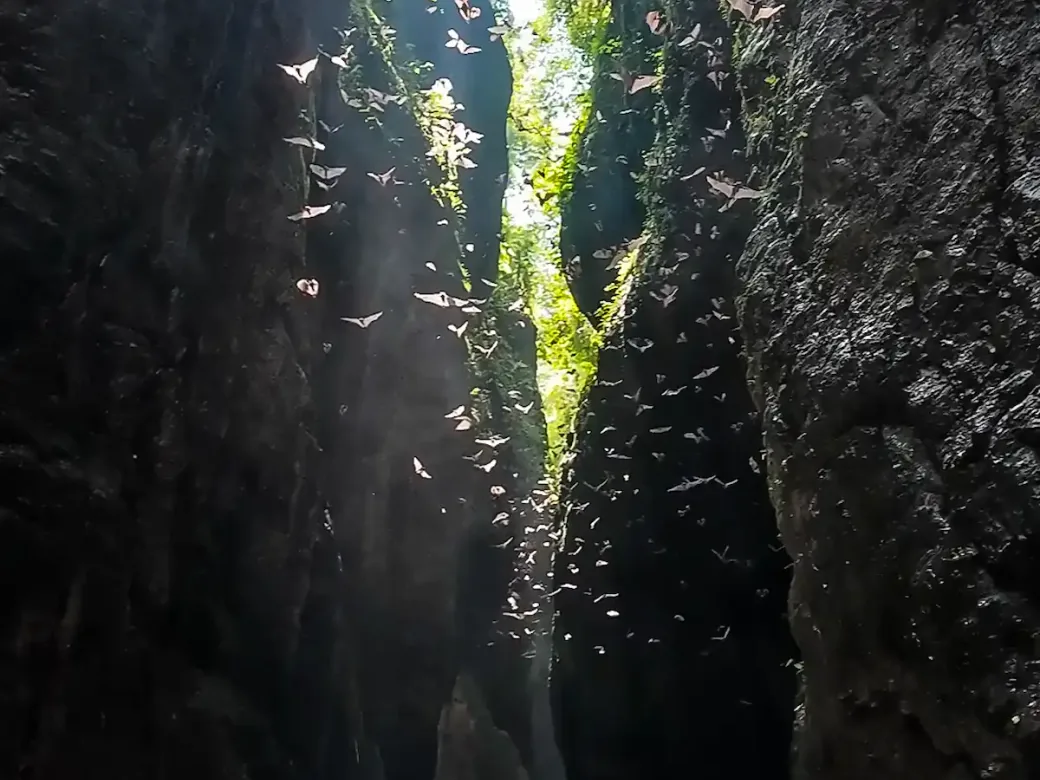
Inside the canyons, the air is humid and the walls are wet for most of the year. There are small caves along the way where bats live.
The routes are in Sukasada district, Buleleng Regency. The rivers start on the border between Wanagiri and Gitgit, and the Sambangan area is next to Panji village.
The Two Main Canyons
Gitgit Canyon
Gitgit is the higher and colder of the two canyons. All of our beginner routes are here.
At a glanceGitgit Canyon
- Location
- Gitgit, Sukasada, Buleleng
- Start point
- -8.212452, 115.135985
- Elevation
- 900 → 700 m above sea level
- Water temperature
- 18–23 °C (64–73 °F)
- Duration
- 1–5 hours, depending on route
- Number of abseils
- 8
- Longest abseil
- 24 m (79 ft)
- Routes
- Easy Flow, Splash, Brave Trail
The water is colder here because the canyon is higher up. You must wear a wetsuit.
The Gitgit canyon has two parts. The first part ends at a hot spring. The second part ends at Gitgit Twin Waterfall, two waterfalls side by side that many tourists visit. You can do one part, or both.
The hot spring makes Gitgit different from every other canyoning route in Bali. It is partway down the canyon, at the end of the Easy Flow route. After one and a half to two hours in water that can be as cold as 18 °C, sitting in the warm water feels great.
As of September 2026, you don’t need to swim on Easy Flow and Splash. But you do need to be OK with heights. This can change if the water level changes, and we will update this page when it does.
Sambangan Canyon (Aling-Aling)
Sambangan is lower, the water is warmer, and the routes are harder.
At a glanceSambangan Canyon
- Location
- Sambangan, Sukasada, Buleleng (bordering Panji)
- Start point
- -8.193887, 115.106300
- Elevation
- 500 → 300 m above sea level
- Water temperature
- 21–24 °C (70–75 °F)
- Duration
- 4–5 hours, combination around 9 hours
- Number of abseils
- 8
- Longest abseil
- 45 m (148 ft)
- Routes
- Asri Challenge, Aling Venture, combination of both
Three degrees warmer may not sound like much, but you will feel the difference after a few hours in the water.
The longest abseil here is 45 meters, almost twice as high as the biggest one at Gitgit. All routes at Sambangan are advanced. If you are not comfortable swimming and jumping, this is not the place for your first canyoning trip.
The canyon ends at Aling-Aling, a waterfall that is already popular with tourists. Most people walk to Aling-Aling from below, using the stairs. On the canyon route, you arrive from the top, through a part of the river you cannot reach any other way.
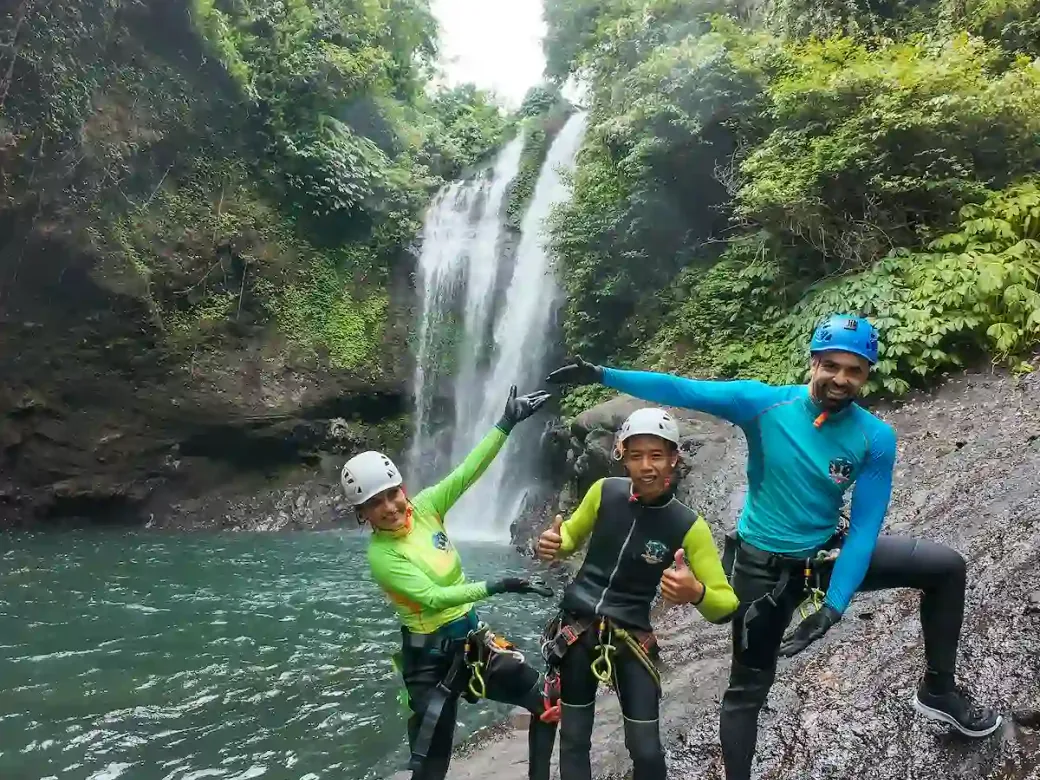
There are several bat caves on this route, with more bats than at Gitgit.
Gitgit or Sambangan?
| Compare | Gitgit Canyon | Sambangan (Aling-Aling) |
|---|---|---|
| Elevation | 900 → 700 m | 500 → 300 m |
| Water temperature | 18–23 °C (64–73 °F) | 21–24 °C (70–75 °F) |
| Longest abseil | 24 m (79 ft) | 45 m (148 ft) |
| Duration | 1–5 hours | 4–9 hours |
| Level | Beginner to medium | Advanced |
| Minimum age | 6+ (Easy Flow, Splash), 16+ (Brave Trail) | 16+ |
| What’s special | hot spring on the route | bat caves, 45 m abseil |
| Finish point | hot spring or Gitgit Twin Waterfall | Aling-Aling |
| Swimming required | no (Easy Flow, Splash), recommended (Brave Trail) | strongly recommended (Asri Challenge), required (Aling Venture, combination) |
If it is your first time canyoning, or you are not sure about swimming, start with Gitgit. If you are comfortable in the water and with jumping, and you want higher abseils and to finish at a famous waterfall, choose Sambangan.
Routes and Difficulty
There are six routes in the two areas: three at Gitgit and three at Sambangan.
| Route | Area | Level | Duration | Minimum age | Swimming required |
|---|---|---|---|---|---|
| Easy Flow | Gitgit | Beginner | 1.5–2 hours | 6 | No |
| Splash | Gitgit | Beginner | about 1 hour | 6 | No |
| Brave Trail | Gitgit | Medium | about 5 hours | 16 | Recommended |
| Asri Challenge | Sambangan | Advanced | about 4 hours | 16 | Strongly recommended |
| Aling Venture | Sambangan | Advanced | about 5 hours | 16 | Yes |
| Asri + Aling | Sambangan | Advanced | about 9 hours | 16 | Yes |
All times are estimates. A trip can be shorter or longer, depending on the size of the group and how fast it moves.
Gitgit routes
Easy Flow. The first part of the Gitgit canyon, ending at the hot spring. It takes 1.5 to 2 hours. Good if you want to try canyoning without spending the whole day.
Splash. The second part of the Gitgit canyon, ending at Gitgit Twin Waterfall. It is short, about 1 hour, but it has the longest abseil and zip line at Gitgit, plus a Tarzan swing. Hotel transfer and breakfast are not included on Splash.
Brave Trail. Easy Flow and Splash together. You pass the hot spring and continue to the twin waterfall. About 5 hours, and more tiring than the other two.
Sambangan routes
Asri Challenge. There are few emergency exits along the way, and you can’t skip some of the jumps. About 4 hours.
Aling Venture. Everything on this route is required, including the jumps and the swimming parts. One swim is 50 meters (164 ft) long. About 5 hours. Only open from May to October.
Asri Challenge + Aling Venture. Both Sambangan routes in one day, about 9 hours. This is the longest and hardest of the six routes. You must be able to swim. Because it includes Aling Venture, it is also only open from May to October.
Why Aling Venture is only open from May to October
This is for safety, not because of the weather.
Aling Venture has very few exits. If the water rises while you are in the canyon, there are very few places to get out. In the dry season, we can manage this risk. In the wet season, the water can rise very fast, and you cannot see it coming.
So the route is closed from November to April. It is not impossible to do, but if something goes wrong, there are not many ways out.
Difficulty levels
We use the same three levels for all routes:
Beginner. No swimming needed, a shorter route, and easy exits. Easy Flow and Splash.
Medium. Swimming recommended, a longer and more tiring route. Brave Trail.
Advanced. You must be comfortable swimming and jumping. Long routes with few exits. Asri Challenge, Aling Venture, and both together.
Who Can Join
Beginners can join. Most of our guests have never done canyoning before.
Before you go down, there is a briefing. We show you the gear you wear, how it holds your weight, and what to do on each type of ground. Your guide sets up and checks every anchor point before you use it.
Before you choose a route:
If you can’t swim
- Easy Flow and Splash (as of September 2026): yes, if heights are not a big problem for you
- Brave Trail: swimming recommended
- Asri Challenge: not recommended
- Aling Venture: no
- Asri + Aling: not at all
If you don’t want to jump
On Asri Challenge, you can’t skip some of the jumps. On Aling Venture, all jumps are required. If you don’t want to jump, these two routes are not for you.
If you are afraid of heights
The first abseil is usually the hardest part. Most people feel better after that. But if your fear is so strong that you freeze halfway down, it is hard for you and for your guide.
If you have a very strong fear of heights, we don’t recommend canyoning. If you still want to try, choose Easy Flow or Splash. On both routes, it is easy to stop and leave partway if you need to.
Age
Easy Flow and Splash: from age 6. Brave Trail, Asri Challenge, Aling Venture, and Asri + Aling: from age 16. The maximum age on every route is 65.
Weight
30 to 130 kg (66 to 287 lb).
Health
You can’t join if you are pregnant, have a heart condition, or have a very strong fear of heights. Also make sure you are fit and feel well on the day.
We prefer to tell you now if a route is not right for you, not halfway down the canyon.
Is It Safe? Why You Need a Guide
Canyoning is safe when it is done with good preparation and a guide. Without these, it is not safe.
We don’t recommend going into these canyons without a guide, even if you have done the route before. There are three reasons.
Anchor points are not permanent, and you can’t always see them
The safety points must be set up, checked, and sometimes moved, depending on the conditions. Floods can damage them. If you don’t know which ones are safe today, you can’t tell just by looking.
Exits are not marked
On most routes, only people who have done the route many times know where you can get out. If you need to leave early, this is what matters.
The water can rise without warning
The rain that raises the water usually falls higher up the river, not where you are. The sky above you can be clear while the water is already rising.
No route is “easy” on its own. A route becomes easy when a good guide leads it.
Our guides
Our guides have more than nine years of canyoning experience. There are at least 2 guides for every 6 guests, so a group of 12 goes with 4 guides. If there are children in the group, we add more guides.
Equipment
Our safety gear meets CE (Conformité Européenne) and UIAA (Union Internationale des Associations d’Alpinisme) standards, from brands such as Petzl, Tendon, and Black Diamond. We check every piece before and after each trip. When gear no longer works properly, we stop using it and recycle it.
If the weather changes on the day
The guides and the Bali Canyoning Trip team decide. If it is not safe, we move the trip to another day, change to another route, or give you a refund.
When to Go and What to Bring
Time of day
Trips start at about 8:30 am. Short routes like Easy Flow and Splash finish before noon. Longer routes go into the afternoon.
We start early because of the rain, not the heat. Rain in the mountains above the canyon usually falls in the afternoon. The canyon water comes from there, so afternoon rain can raise the water in your part of the canyon one or two hours later, even if it is still dry where you are.
In the morning, the water temperature is also more stable. After rain, the water can get a few degrees colder and harder to see through. How much depends on the weather after the rain: cloudy or sunny.
Time of year
Bali has two seasons: the dry season, from about May to October, and the wet season, from about November to April.
The dry season is the best time for canyoning in Buleleng. The water levels are more stable, and the routes are easier to predict.
Aling Venture and Asri + Aling are only open in the dry season. The other routes are open all year. In the wet season, we check each route the day before your trip to see if it is open. The Aling-Aling management also usually tells us when it is closed.
What to bring
- Swimwear (normal underwear is also fine)
- A change of clothes
- Your own socks, if you prefer (we also provide socks)
- Personal items, like sunscreen, or prescription glasses if you wear them
What’s included
- Professional guides
- Hotel transfer (except Splash)
- Full gear: helmet, full-body wetsuit, harness with all safety equipment, socks, and shoes
- Safety briefing
- Breakfast (except Splash) and lunch
- Coffee and tea break
- Photos and video
- Insurance
Don’t bring valuables like jewelry, expensive watches, or phones. We take an action camera into the canyon, so you will still get photos and videos.
Getting there
The meeting point is the Bali Canyoning Trip basecamp: view on Google Maps.
We pick you up from anywhere in Bali (not on Splash). We drop you off at the same place, or close to it. A different drop-off place may cost extra.
Depending on the route, the trip takes half a day to a full day, including the drive.
Cost
From IDR 500,000 to IDR 2,990,000 per person, depending on the route. You can see the price of each route on the trip page.
Respect for the Water and the Villages
The water in these canyons is the same water that people living below use for drinking and at home.
So we have rules on our trips. No soap or shampoo in the canyon. We take out everything we bring in. If you need to go to the toilet, there is a set way to do it, and we explain it in the briefing.
We also need permission to use these canyons. At each site, we have permission from the traditional village (desa adat), the village government, and the village-owned business (BUMDes):
Gitgit
Desa Adat Gunung Luwih, Gitgit Village, and BUMDes Satya Mandala Giri
Sambangan
Desa Adat Sambangan, Sambangan Village, and BUMDes Kertha Partha
We also work with the local groups that manage the waterfalls at each site. Part of your payment goes to the village funds, to the groups that manage places like Gitgit Twin Waterfall, and to the landowners.
If you are choosing a canyoning company here, it is fair to ask who gave them permission and where the money goes. Not every company can answer.
Where to Start
If you have never done canyoning, start with Easy Flow or Splash at Gitgit. If you have done it before and want a longer day, Asri Challenge and Aling Venture together is the hardest option.
We have routes for every level, from routes for complete beginners to routes that need strong swimming and good fitness.
Route details, prices, and availability are at balicanyoning.com/trips.
We check the route information on this page on site and update it when conditions change. Last updated October 2026.
Written by I Gede Yogik Adnyana, host at Bali Canyoning Trip, who has been running canyoning trips in Gitgit for four years.
Canyoning levels in Bali
Frequently asked questions
No. Most of our guests have never done canyoning before. Easy Flow and Splash at Gitgit are the beginner routes. Before you start, a briefing explains your gear and what to do on each type of ground.
It depends on the route. On Asri Challenge, you can't skip some of the jumps. On Aling Venture, all jumps are required. If you don't want to jump, choose another route.
From about 1 hour (Splash) to about 9 hours (Asri Challenge and Aling Venture together). With the drive, plan for half a day to a full day.
Swimwear, a change of clothes, and personal items like sunscreen or prescription glasses. We provide the helmet, full-body wetsuit, harness, socks and shoes. Leave valuables, like your phone, behind: we film the trip with an action camera.
Ready to experience canyoning in Bali?
It's more than visiting waterfalls — it's moving through nature in a way that feels active, immersive and real. Whichever level you choose, every trip is guided safely, step by step. The only thing left is choosing your adventure.
Explore All Trips